This excellent post was written by Kamala Lopez of Equal Means Equal and reprinted here with permission.
The topic and the framing of this article is so timely that we wish to give it more exposure, given the fact that we are experiencing attacks on women’s rights across the political spectrum and we are flirting with annihilation due to men’s obsession with domination and force. It is time to rethink all of our institutions, which have been originated by men, cultivated by men, and which are severely limited, hampered, and blinkered by the male viewpoint. And it is past time that women had a seat at the table with the power brokers, or better yet, were at the helm of the Ship of State.
We offer this as a fundamental analysis of what has gone wrong, from the beginnings of patriarchal society, and the desperate need for balance, for equilibrium, in the egalitarian execution of power and authority, and in who decides society’s values.
***************************************************************
SOCIAL EQUILIBRIUM REQUIRES WOMEN’S EQUALITY
What if women’s equality is not simply a matter of justice, but something human civilization needs to survive?

September 2026
Something is profoundly out of balance.
What we are presently witnessing in the world is evidence of a deeper imbalance in the way human beings have organized power itself — what we reward, what we admire, what we protect, whose experiences we value, and what we are willing to sacrifice in the pursuit of dominance, security, wealth or control.
Human beings have become extraordinarily powerful. We have developed technologies capable of connecting billions of people instantaneously, but also of monitoring and manipulating them.
We possess weapons capable of destroying entire populations and economic systems capable of generating previously unimaginable wealth, even as millions struggle to meet basic human needs.
We have acquired the ability to alter, on a planetary scale, the natural systems upon which our lives depend, while remaining bitterly divided over our responsibility to preserve them.
Our capacity to exercise power has accelerated at a breathtaking rate. But what of our capacity to exercise that power wisely?
This moment requires us to look beyond the crisis immediately in front of us to what kind of society our understanding of power has produced, what values have been elevated in constructing it, and what human capacities we have consistently undervalued along the way.
The task is not simply to stop things from getting worse, but to understand what it would take to bring us into balance.
The Experiment Humanity Has Never Conducted
Human beings have experimented with almost every imaginable way of organizing ourselves. We have lived under monarchies and republics, democracies and dictatorships, empires and federations. We have organized economies around feudalism, capitalism, socialism, communism and innumerable combinations of them. We have concentrated power in kings, parliaments, parties, corporations, religious authorities and revolutionary movements.
But across these vastly different systems, one variable has remained remarkably constant: men have overwhelmingly held vastly more institutional power than women.
That fact makes it difficult to know what a genuinely balanced human civilization would look like, because we have never actually built one.
To understand what that imbalance may have meant for the civilizations we did build, we have to look at something more fundamental than the particular forms their governments took. We have to look at the underlying bargain about how human beings agree to live together and what we decide matters.
Every Society Rests Upon a Bargain About What Matters
One of the oldest questions in political philosophy is also one of the simplest: Why should one human being have the right to tell another human being what they can and cannot do?
Wherever human beings have lived together, societies have needed ways of deciding who holds authority, how decisions are made, what obligations people have to one another, how resources are shared, how conflicts are resolved and what responsibilities the community assumes for its members.
The answers have taken radically different forms across cultures and across time. Long before European colonization, for example, Indigenous peoples throughout the Americas had developed complex and widely varying systems of government, diplomacy, alliance and collective decision-making.¹
One particularly relevant example is the Haudenosaunee Confederacy, formed by the Mohawk, Oneida, Onondaga, Cayuga and Seneca nations, and later joined by the Tuscarora. Its Great Law of Peace established a system of government based upon consensus and principles intended to preserve peace through reason rather than force.² And significantly for the questions we will eventually be asking here, women were not simply subjects of that political order. Haudenosaunee clan mothers held substantial authority within it. They selected the male leaders who served on the Grand Council and possessed the authority to remove a leader who failed to serve the interests of the people.³
Centuries later, a particular tradition of European political philosophy addressed legitimate authority through an idea that would profoundly influence the political institutions of the modern West: the social contract.
At its heart was the principle that the exercise of power over other human beings requires justification.
We live with the consequences of that bargain every day. We agree not to drive through red lights. We pay taxes—although the obligation to support the society from which we benefit is hardly distributed equally. We accept restrictions on our individual freedom that make it possible for millions of people to live together, and we grant government the extraordinary authority to make laws, enforce them and punish those who violate them. In exchange, we expect certain things: that the law will protect us, that our rights will be respected, that public institutions will function, and that the enormous power we have entrusted to government will be exercised according to rules rather than the whims of whoever happens to possess it.
There is no actual contract, of course. None of us was handed a document at birth and asked whether we agreed to the terms. The social contract is a philosophical way of asking what could justify the authority that government exercises over us.
At its core lies the idea that legitimate political authority must rest, in some meaningful sense, upon the agreement or consent of the people who live under it. What constitutes meaningful consent—and what people would reasonably agree to—has produced centuries of argument.⁴

John Locke (England, 1632–1704) argued that human beings are naturally “free, equal, and independent,” and that no person can legitimately be subjected to another’s political power without consent. People create government in order to live together securely and protect their rights, but government does not therefore acquire unlimited authority over them; its legitimate authority derives from the consent of the people who have entrusted it with power.5
Jean-Jacques Rousseau (Geneva/Switzerland, 1712–1778) approached legitimate authority through collective self-government: human beings could live together under laws and nevertheless remain free only if those laws expressed what he called the “general will of the people” who were themselves required to obey them.6
Political power requires justification.
The fact that someone possesses power does not, by itself, establish a moral right to exercise it over someone else. The people who must live under a political order must therefore figure into the legitimacy of that order.
Every society embodies choices about what it will protect and what it will tolerate; what it will reward and what it will neglect; what individuals owe one another and what they owe the larger community; whose freedom must be protected and under what circumstances it may be constrained; which forms of work are valuable; whose suffering demands a collective response; and what obligations the living have to those who will come after us. We may never sit around a table and negotiate these terms, but together they constitute a bargain about what matters.
That bargain is expressed in our constitutions and laws, but it is also embedded in our institutions, our economic systems, our customs and our assumptions about what—and who—is valuable. And because those arrangements were created by human beings rather than handed down by nature, they reflect the histories, interests, experiences and values of those who had the power to shape them.
Who Got to Negotiate the Bargain?
For most of recorded history, the answer is clear: men did. Overwhelmingly.
Certainly, there have been cultures in which women exercised forms of political, economic and social authority that complicate any simple story of universal male rule. But the institutions that eventually came to dominate much of the modern world—governments, legal systems, militaries, organized religions, systems of property and commerce, universities and, eventually, corporations—developed overwhelmingly under conditions in which formal authority belonged to men.
Yet women were at the heart of civilization’s creation. They did much of the work without which civilization could not have existed at all.
Women transmitted knowledge and culture across generations and performed enormous amounts of agricultural and other productive labor. They bore and raised children, produced and prepared food, cared for the sick and elderly, maintained households, preserved relationships and communities. The precise division of that work varied tremendously across societies, classes and historical periods, but one fact is remarkably persistent: the work necessary to sustain human life, largely done by women, very rarely brought with it the authority commensurate with its importance to human survival.
Recognized authority—the power to own and control property, interpret religious doctrine, command armies, govern institutions, make laws and determine who would be bound by them—remained overwhelmingly in male hands.
The contradiction is particularly striking in the European social-contract tradition itself. Locke could write that human beings were naturally “free, equal, and independent” in a world in which women did not possess anything approaching equal political or legal authority. Rousseau could construct a theory in which legitimate law derived from the collective self-government of the people while imagining political citizenship as fundamentally male.
The contradiction is not incidental to the history of the social contract. It exposes a problem at its center: Who counts as one of the people whose consent makes political authority legitimate?
The same problem followed the social-contract tradition across the Atlantic. The United States would proclaim as a foundational principle that “all men are created equal” while constructing a political order that denied most of the people living within it any equal role in determining its terms. Enslaved people were held as property. Women were legally subordinated to fathers and husbands. Indigenous peoples were displaced and denied the sovereignty they already possessed. Many Americans without property, female and male, lived under laws they had no equal political authority to make or change. The language of universal liberty emerged alongside systems that defined very narrowly who was entitled to exercise it.
What is often invisible is the extent to which institutions carry their histories forward. Systems of government, law, economics and social organization do not disappear and begin again every generation. They evolve, certainly, but from what original point of departure? We inherit them, modify them, fight over them and occasionally transform them, but we begin with structures already built and assumptions already embedded within them.
Women eventually forced their way into many of the institutions from which they had been excluded. They acquired property rights, entered universities and professions, won political rights, held public office, built businesses, joined militaries and assumed positions of authority that had been explicitly denied to previous generations of women.
But entering an existing system is not the same thing as having equal power to determine the values upon which that system was built.
If the institutions that have exercised the greatest power over human civilization were shaped during centuries in which women did not possess equal authority within them, then our social contract was necessarily shaped without the full range of women’s experience, knowledge and values.
Which Human Values Have Power?
The consequences to society of women’s exclusion from equal authority extend to which human values our institutions learned to recognize and reward.

For centuries, the institutions with the greatest formal power—government, organized religion, law, commerce and the military—were overwhelmingly controlled by men, and they developed within cultures that assigned distinctly different and often rigid roles to men and women.
Men were generally expected to operate in the public sphere: governing, fighting, trading, acquiring property, competing for status and accumulating wealth. Women were largely assigned responsibility for the private sphere: bearing and raising children, caring for the sick and elderly, feeding families, maintaining households and sustaining the relationships upon which communities depended.
Over time, these divisions created a profound disparity not simply in who possessed power, but in what kinds of human activity were understood to matter. The work associated with the public sphere acquired money, status and institutional authority. The work associated with sustaining human beings was more likely to be unpaid, invisible or simply expected.
As a result, the qualities that powerful institutions tended to reward—competition, conquest, accumulation, dominance, individual achievement and control—reinforced the qualities traditionally associated with masculinity and the roles assigned to men. Meanwhile, cooperation, caregiving, empathy, interdependence, restraint and responsibility for the vulnerable and for future generations were more often associated with femininity and relegated to the private sphere.*
And so, societies built under conditions of overwhelming male institutional power privileged certain human values over others—and that imbalance became embedded in the institutions we inherited.
But simply allowing women to enter those institutions will not necessarily correct it. As we’ve seen, women can achieve extraordinary things within systems whose fundamental definitions of success, value and power have already been established without necessarily changing what the hierarchy rewards.
The potential to truly reshape the social contract lies in women having enough power to change what power itself values.
*Those qualities don’t belong inherently to either sex. Men are capable of extraordinary care, empathy, cooperation and sacrifice; women can be competitive, aggressive, acquisitive and authoritarian. Human beings contain all of these capacities, and culture profoundly influences which ones we are encouraged to develop and rewarded for exercising.
What Happens When Women Have Power?

If excluding women from power profoundly affected which human needs our institutions recognized and valued, then giving women meaningful political authority should change what those institutions see and what they do.
There is evidence that it does.
One of the clearest examples comes from India, where a constitutional reform required one-third of village council leadership positions to be reserved for women. Because the councils receiving female leaders were selected randomly, economists Raghabendra Chattopadhyay and Esther Duflo were able to compare otherwise similar communities governed by women and men. What they found was not simply that women governed differently. They invested differently.
Women leaders directed significantly more resources toward infrastructure particularly important to the daily lives of rural women, including drinking water, while male leaders invested more heavily in other priorities. Women were also more likely to participate in the political process when their village was led by a woman.7
The need for clean water had always existed. Women had always been carrying water, using it to feed their families and dealing with the consequences when access was inadequate. What changed was not the need. What changed was who had the authority to make the need visible to government.
Another study from India found something initially disturbing: as women’s representation in local government increased, officially recorded crimes against women increased as well. But researchers Lakshmi Iyer, Anandi Mani, Prachi Mishra and Petia Topalova found evidence that the increase reflected greater reporting of violence rather than greater incidence of violence.
More women in political power had apparently changed women’s willingness or ability to bring violence against them into the official record. And interestingly, broad female membership on local councils mattered more than simply placing individual women in higher-level leadership positions.8
Again, the violence had not suddenly appeared. Government had become better able to see it.
The consequences of women’s participation in power become particularly consequential in decisions of war and peace, where the lives of thousands—or millions—of human beings may hang in the balance.
Research examining more than 270,000 candidates across 50 countries found that when women won legislative office, subsequent foreign military actions decreased in countries where legislatures had the power to constrain military deployment. Women legislators also influenced how their colleagues voted on the use of military force. When women had a meaningful voice in decisions about war, those decisions changed.9
Experience affects perception, and perception affects what power notices. When people who have lived different experiences acquire meaningful authority—not merely symbolic presence—they can bring previously marginalized needs into the field of political vision.
The evidence from India suggests something larger than a difference in policy preferences. When women gain meaningful authority, experiences that have historically remained outside the field of institutional power begin to enter it. Water becomes not merely something women carry, but infrastructure government must provide. Violence against women becomes not merely something endured in private, but something the state is required to recognize and address.
These are not peripheral concerns. They are the infrastructure of human survival. Clean water, food, health, safety, education, care, a livable environment and the ability to raise the next generation are not secondary to the functioning of a society; they are the reason a society needs to function in the first place. Yet we have become accustomed to measuring the success of our societies through other forms of achievement—economic growth, productivity, technological advancement, military strength and the accumulation of wealth.
Women’s equal power has implications beyond whether government pays greater attention to certain neglected needs.
It challenges what we have been using to measure human progress itself.
Human beings learn from what they are required to do. Experience produces knowledge, and responsibility produces expertise. And when particular experiences are systematically concentrated among people who are simultaneously excluded from power, the knowledge gained through those experiences is less likely to shape the decisions power makes.
That may be one of the most consequential losses produced by inequality. A society can possess extraordinary technological, military and economic power while remaining remarkably unsophisticated about the human systems upon which its own survival depends.
We can know how to produce more without knowing when enough is enough; how to dominate without knowing when restraint is necessary; how to measure economic growth without adequately measuring the human cost of achieving it.
What becomes visible when women have equal power, then, is not a collection of “women’s issues” at all.
What becomes visible is what it actually takes to keep human beings alive.
Seen from this perspective, women’s equality is no longer only about what women are entitled to. It is also about what society needs.
Those who possess power shape what institutions see, what they value and what they do. When women’s experience, knowledge and strengths are left out of the equation, society loses access to knowledge essential to human survival.
We have been making decisions about human welfare, economic systems, technology, the environment, violence, war and the future while blindly excluding the experience of more than half of humanity from equal authority in shaping those decisions.
The exclusion of women from equal power is not merely an injustice perpetrated against women; it is a structural limitation imposed upon society as a whole.
Inequality harms not only the people denied equality; it may ultimately threaten the continued existence of the society that perpetuates it.
Dangerous Imbalance Meets Unprecedented Power
The stakes are particularly urgent now because human beings have never possessed this much power before.
Our power is accelerating faster than our ability to agree upon the values that should govern it, while women still do not possess equal power to construct the rules of the game. That combination should alarm us: unprecedented human power operating through institutions built upon an inherited imbalance of human power.
The social contract was never static. Every generation has inherited institutions built for an earlier world and modified them to confront circumstances their predecessors could not have imagined. Yet we continue to rely on a social contract constructed for a world that no longer exists, even as the scale and speed of human power are transforming the conditions under which we live.
Our capacity to exercise power has outrun our capacity to govern it. Rebalancing whose voices shape that power is no longer something humanity can afford to postpone.
The American Question

If women’s equal participation in power is necessary to the legitimacy of the social contract, then equality cannot remain something we hope institutions will gradually achieve. It has to become one of the principles upon which those institutions are required to operate.
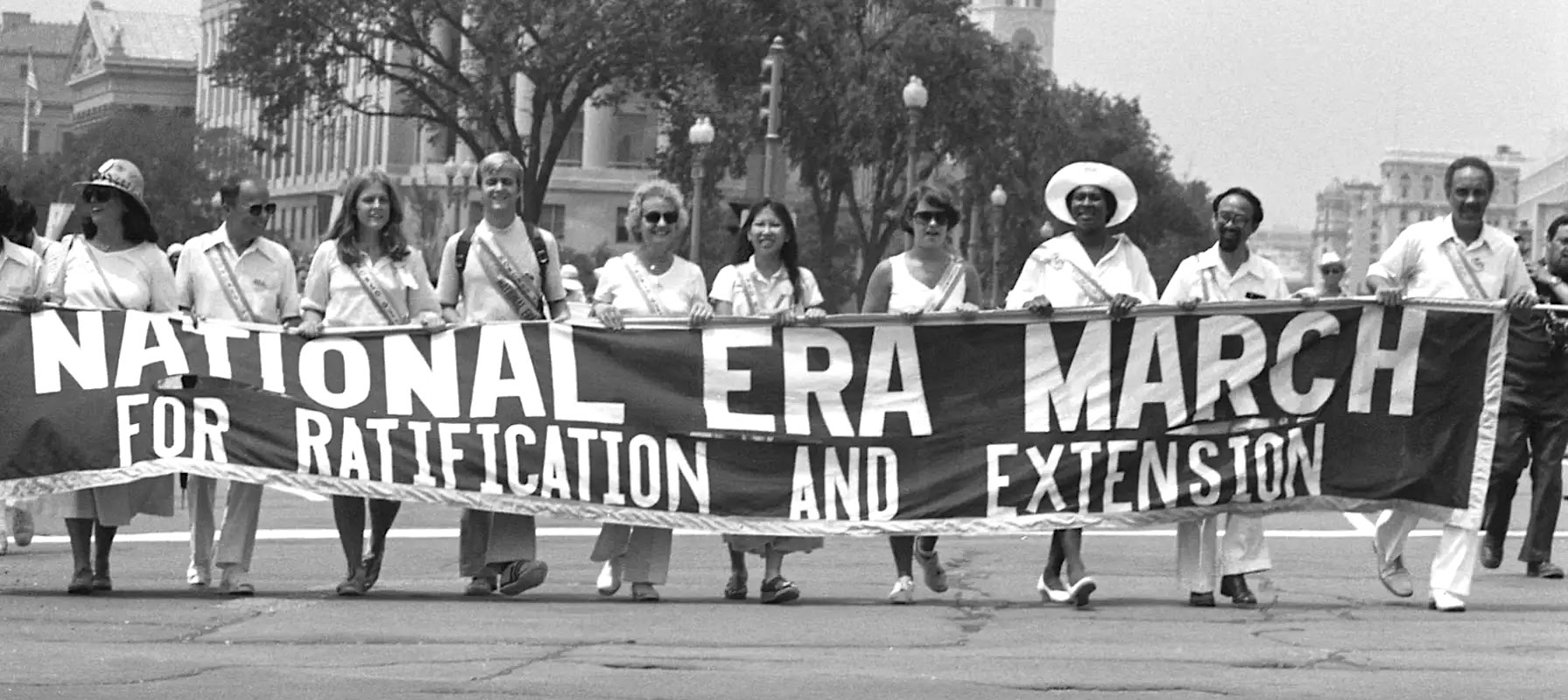
Nearly a century after the Equal Rights Amendment was first introduced, and more than half a century after Congress finally sent it to the states, the United States still does not officially recognize it as part of our Constitution.
Thirty-eight states have ratified the ERA—the number Article V requires—but the National Archives continues to refuse to certify and publish it, relying on the position that Congress’s ratification deadline was legally enforceable and had expired before the final three states acted. Constitutional scholars, advocates and public officials have disputed that conclusion, and President Biden declared in January 2025 that he believed the ERA had been ratified and was the law of the land. Yet the amendment remains unpublished, and the National Archives’ stated position is that it cannot legally publish the ERA under existing legal precedents unless Congress or the courts act.10
We are asking who gets to shape the social contract and whether humanity can afford to continue making consequential decisions without women possessing equal authority—and the Constitution of the United States still does not contain an explicit guarantee that equality of rights cannot be denied or abridged on account of sex.
The Constitution is the legal embodiment of the American social contract.
It establishes the fundamental principles upon which we agree to govern ourselves: who may exercise power, where that power comes from, what limits are placed upon it and which rights cannot legitimately be bargained away when political majorities, governments or circumstances change.
Equality between women and men must be one of those fundamental principles, and therefore it belongs there.
The ERA has traditionally been understood as something women have sought from the Constitution: protection against unequal treatment, a stronger legal foundation for challenging sex discrimination and formal recognition of women’s equal status under law.
But the Constitution itself was devised without the equal benefit of women’s intellect, experience and knowledge of human life.
The people who determined its original terms—and the institutions, rights and relationships of power it established—did so without women participating on equal political terms.
That is not simply an injustice embedded in the social contract. It is a blind spot in the social contract itself.
Perhaps the Constitution needs the Equal Rights Amendment as much as women do.
A political system that derives its legitimacy from “We the People” cannot indefinitely leave the constitutional equality of more than half of those people unresolved. And a society confronting decisions of unprecedented consequence cannot afford institutions whose foundational governing document fails to state unequivocally that women and men stand equal before the law.
The ERA therefore belongs not only to the history of the women’s movement but to the future of the American social contract. It would protect women within the system we inherited while establishing something more fundamental: women must possess equal authority in determining what that system becomes next.
The Experiment We Must Conduct
We know that when women acquire meaningful authority, institutions can begin to recognize different problems, respond to different needs and make different choices.
But even those experiments have taken place inside systems whose fundamental architecture was already established.
What we do not know is what would happen if women possessed equal power not simply to participate in those systems, but to reimagine them.
What would our economies measure?
What would we consider security?
What would we consider prosperity?
How would we value care?
What obligations would we recognize toward children, the elderly, the vulnerable, the natural world, and generations not yet born?
What would we ask technology to accomplish?
When would we decide that the exercise of power requires restraint?
I don’t know the answers to those questions. None of us does.
We have spent thousands of years experimenting with different ways of arranging human civilization while leaving one of its most fundamental arrangements essentially unchanged.
We have repeatedly changed the form of government, the organization of the economy, the distribution of property, the boundaries of nations and the technologies through which power is exercised.
But we have never tried balance.
Notes
¹ Smithsonian National Museum of the American Indian, Native Knowledge 360°, “Essential Understandings.” NMAI documents the complex and varied systems of government, diplomacy, alliance, war and peacemaking developed by Indigenous peoples in the Americas long before European colonization.
² Smithsonian National Museum of the American Indian, Native Knowledge 360°, “American Revolution: Haudenosaunee Perseverance.” The Smithsonian describes the Great Law of Peace as emphasizing the power of reason rather than force in preserving peace.
³ Smithsonian National Museum of the American Indian, Native Knowledge 360°, “American Revolution: Haudenosaunee Perseverance.” Clan mothers select male leaders and possess authority to remove a leader who fails to serve the interests of his people.
⁴ Stanford Encyclopedia of Philosophy, “Legal Obligation and Authority.” Social-contract traditions address the conditions under which political authority can legitimately bind those subject to it.
⁵ Stanford Encyclopedia of Philosophy, “Locke’s Political Philosophy.” Locke’s political theory grounds legitimate government in the natural freedom and equality of individuals and in consent to political authority.
⁶ Stanford Encyclopedia of Philosophy, “Jean Jacques Rousseau.” Rousseau’s account of the general will connects legitimate law with collective self-government; his conception of political citizenship nevertheless excluded women.
⁷ Raghabendra Chattopadhyay and Esther Duflo, “Women as Policy Makers: Evidence from a India-Wide Randomized Policy Experiment,” Econometrica 72, no. 5 (2004): 1409–1444.
⁸ Lakshmi Iyer, Anandi Mani, Prachi Mishra and Petia Topalova, “The Power of Political Voice: Women’s Political Representation and Crime in India,” American Economic Journal: Applied Economics 4, no. 4 (2012): 165–193.
⁹ Kyosuke Kikuta, “More Equality for Women Does Mean Less War: Descriptive Representation, Legislative Votes, and International Conflict,” Comparative Political Studies 59, no. 1 (2026): 110–154.
¹⁰ National Archives and Records Administration, “Statement on the Equal Rights Amendment Ratification Process,” December 17, 2024; President Joseph R. Biden Jr., “Statement on the Equal Rights Amendment,” January 17, 2025. NARA stated that under existing legal, judicial and procedural decisions the ERA could not be certified or published without further action by Congress or the courts. Biden subsequently stated that he believed the ERA had become part of the Constitution and was “the law of the land.”
 As expected, the judge ruled that we do have standing because the primary plaintiff is a woman who tried to register for the draft, but was rejected solely because of her sex.

 dical experiment on a vulnerable group of children and teens, mostly girls, who are gender non-conforming, autistic, and/or survivors of trauma, a majority of whom, if provided appropriate support, would be likely to grow up lesbian or gay with their bodies and fertility intact.